
Insights
OEE for maintenance
by OptiPeople Team
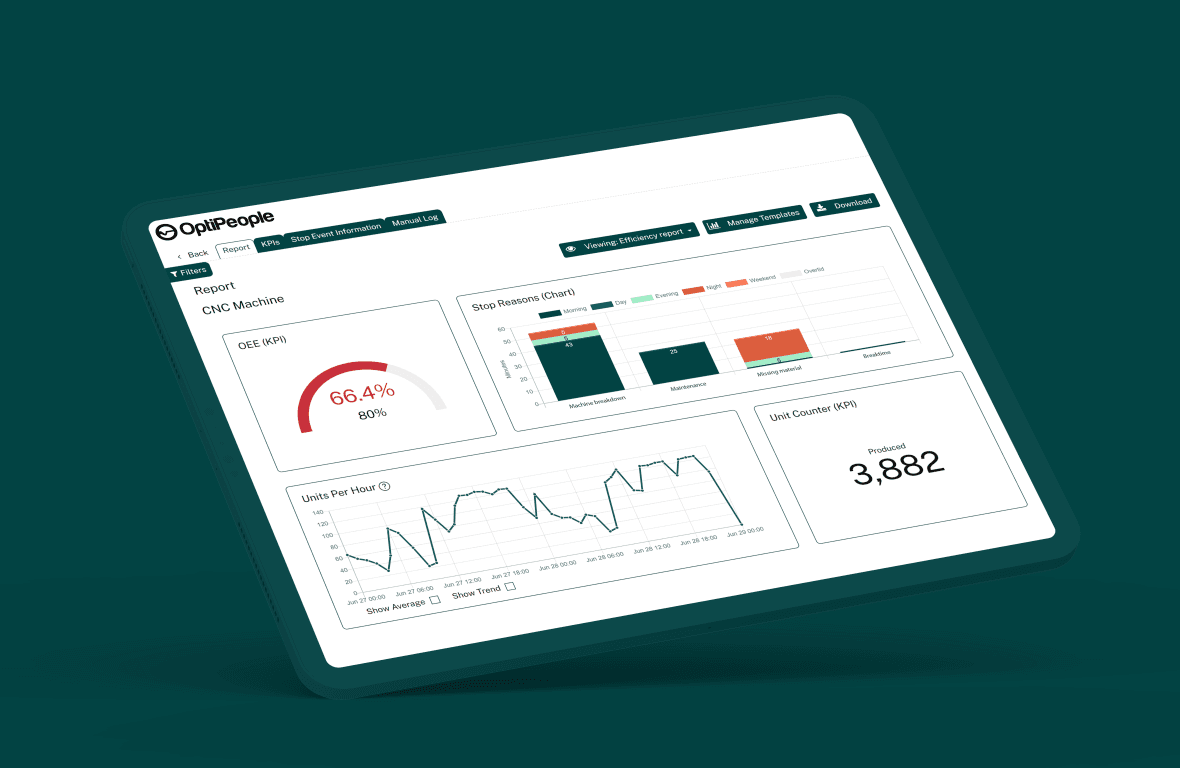
High-performing manufacturing plants depend on performance, quality, and availability. Since machines and facilities are often the most important capital assets in a plant, maintenance plays a central role in competitiveness and output.
One of the most practical KPIs for maintenance teams is OEE, or Overall Equipment Effectiveness.
How is OEE used for maintenance?
Running an OEE evaluation can reveal how maintenance work is planned, organized, and executed.
Low asset availability can indicate:
- frequent breakdowns
- long repair times
- insufficient preventive maintenance
- missing spare parts
Low performance can point to issues such as:
- worn components
- poor lubrication
- outdated belts or bearings
Low quality often points to process failures or lack of standardization.
Begin with a plan
No matter what is produced, all manufacturing plants face the same challenge: machines degrade with time and use.
Because OEE is an overall measure, no machine or asset should be ignored. But two machine groups are usually especially important:
- Income-critical assets: assets directly tied to revenue and margin
- Manufacturing-critical assets: assets that must run reliably for production to continue
Both groups need structured attention if a plant wants stable performance.
Key performance parameters
When machines are maintained to the right standard, they hold resilience longer, reduce scrap, and improve consistency.
For income-critical equipment, it is important to define and monitor Key Performance Parameters (KPPs). These are the measurable values a machine must maintain across its useful life.
Knowing these parameters helps teams:
- maintain machine performance
- reduce unplanned downtime
- protect product quality
Maintenance and reliability planning
Most plants use a combination of maintenance approaches:
- reactive maintenance
- preventive maintenance
- predictive maintenance
- prescriptive maintenance
A strong reliability strategy usually combines these approaches, with preventive and predictive maintenance playing the biggest role in sustaining OEE.
Why OEE matters for maintenance
OEE helps maintenance teams move from guesswork to evidence.
Instead of treating maintenance only as a repair function, OEE makes it possible to connect maintenance quality directly to production performance. That makes it easier to prioritize work, justify improvements, and build a stronger reliability program over time.