
Insights
World-class OEE: What score is it and how to get there
by OptiPeople Team
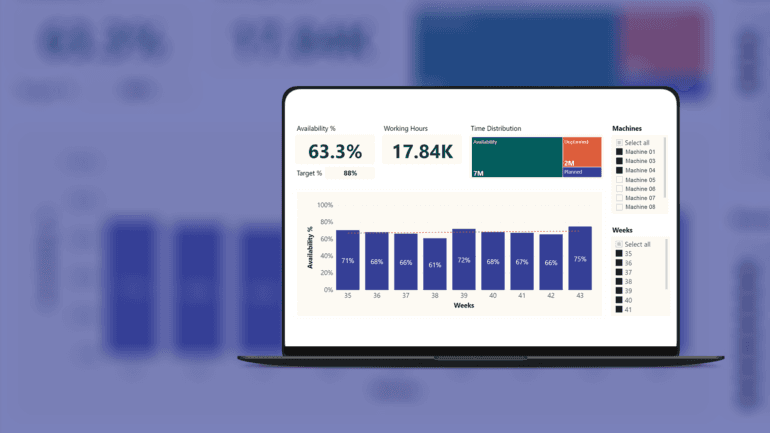
A world-class OEE score is 85%. The benchmark comes from 90% availability, 95% performance and 99.9% quality, multiplied together. Few plants reach it: a typical discrete manufacturer runs around 60%, and 40% is common when a plant first starts measuring. So 85% is a long-term goal, and the right first target is a few points above where you are today.
What is a world-class OEE score?
85%. It is the standard benchmark for discrete manufacturing, and it is built from three factor targets:
World-class OEE = Availability x Performance x Quality
                = 90%          x 95%         x 99.9%
                = 85.4%
| Factor | World class | What it means in practice |
|---|---|---|
| Availability | 90% | Unplanned stops and changeovers take no more than 1 hour in 10 of planned time |
| Performance | 95% | The machine runs close to its ideal speed, with few short stops |
| Quality | 99.9% | About 1 part in 1,000 is scrapped or reworked |
| OEE | 85% | 85% of planned production time makes good parts at full speed |
The benchmark goes back to Seiichi Nakajima and Total Productive Maintenance (TPM). For how OEE itself is defined, see what OEE is.
What OEE do most plants have?
| OEE score | What it means |
|---|---|
| 85% | World class for discrete manufacturing |
| 60% | Typical for discrete manufacturers, with plenty of room to improve |
| 40% | Common when a plant first starts measuring |
In the OptiPeople Data Platform, factories that have just started measuring often see 30 to 40%. That is rarely because they run worse than others. It is because automatic measurement shows the short stops and slow running that shift sheets never recorded.
Is 85% OEE the right target for every plant?
No. 85% is a benchmark for discrete manufacturing with stable, repeating products. It fits less well when:
- You make many products in small batches. More changeovers mean lower availability, even when each changeover is fast.
- You run a continuous process. Process industry often aims higher than 85%, because there are few changeovers.
- The machine is not the bottleneck. A machine that waits for others will have a low OEE no matter what, and raising it gains nothing.
A better target is your own number plus a few points, on the bottleneck machine first. Compare a machine with itself over time, not with a benchmark from another industry.
Why does world-class OEE matter?
Because the gap between your OEE and 85% is capacity you already own. A machine at 60% that reaches 75% makes 25% more good parts in the same hours, with no new machine, no extra shift and no overtime.
Example: a line planned for 80 hours a week runs at 60% OEE, which is 48 hours of good production. At 85% it would be 68 hours. The 20 hours in between are the size of the prize, and the three factors show where they are hidden.
How do you get to world-class OEE?
- Measure automatically. Manual numbers miss short stops and slow running, so you would be aiming at the wrong losses.
- Start with the bottleneck. That is where an extra hour becomes extra output.
- Compare each factor with its world-class target. If availability is 75% and performance is 92%, the gap is in availability.
- Register stop causes and fix the biggest first. A few causes usually take most of the time.
- Shorten changeovers with SMED, and keep settings stable after start-up to cut scrap.
- Move maintenance into planned time, so breakdowns stop taking production hours.
- Raise the target as each level holds. World class is reached in steps, not in one jump.
The guide to improving OEE goes through each step with examples.
How do you track progress toward world-class OEE?
The OptiPeople OEE module collects run time, counts and stops straight from the machines and shows availability, performance, quality and OEE live per machine, line and shift. You see each factor against its target, and the stop causes registered by the operators show what is holding the number back.
FAQ
What is world-class OEE?
World-class OEE is 85%, based on 90% availability, 95% performance and 99.9% quality. It is the standard benchmark for discrete manufacturing.
What is a good OEE score?
85% is world class. Around 60% is typical for discrete manufacturers, and 40% is common when a plant starts measuring. A good score is one that is rising on your bottleneck.
What is the average OEE in manufacturing?
Around 60% for discrete manufacturers. Plants that have just started measuring automatically often see 30 to 40%, because short stops and slow running become visible.
Can OEE be 100%?
Only in theory. 100% means only good parts, at full speed, with no stops at all. If a calculation gives more than 100%, the ideal cycle time is set too slow. See how to calculate OEE.
How long does it take to reach world-class OEE?
Usually years, not months. The first 5 to 10 points often come within months of starting to measure. The last points need stable processes, fast changeovers and planned maintenance working together.